A little bit of something to inspire you all.....the end could really read: Art=Risk
http://www.youtube.com/watch?v=RmTxr7OsPj0&feature=player_embedded

October 4th - The human head
In today's class be examining the human head, including the face. We are going to pay particular attention to the structure of the cranium, the relationship and placement of the various feature of the face on the skull, and to the space surrounding the head. In addition to trying to capture the correct structure and likeness of the model, we will also be focusing on the expression of feeling that the process we choose to draw a head can give the drawing. Some former students drawings are below.


 Above is a little drawing by Joe Adolphe. His choice of paper to draw on (that is an actual old library card) helps to support the subject and mood. You can see more of this series on his website (a link is on the left) Below are two drawings by the amazing artist Katherine Kollwitz. She always has such amazing emotion in her drawings.

 Below you see two etchings by Lucian Frued. He is a master of giving a feeling mass, and flesh to the head.

 Below are two small Rembrandt's. The style and mediue give a very different feeling to each drawing.

 Last we have two John Singer Sargent drawings. Notice how very visible (nd effective) his line are that he is using to build up the spaces around the head, and the relationship that that creats to the handling of the face.


Here are some other examples by some artist you might be more familar with. Notice the wide variety of techniques used, and the differnet effects that they achieve. First two Van Gogh drawings:


September 27 - The Figure / Ground relationship
For today's class we will be discussing further the use of value and how it can be used to give shape to forms. In particular the human form. We will also use value to help in creating a solid foundation for the figure as we begin to discuss and execute the figure / ground relationship. Starting with small 3 value thumb nails to make sure we good composition, we will develop one charcoal drawing over the day.
Below are some examples of how value can be used to give a sense of volume, space and weight to the firgure in an environment.


Below are some examples of how value can be used to give a sense of volume, space and weight to the firgure in an environment.


Homework samples -Degas Still Life
Here are some completed drawings from some prior students. Remember that Degas often used alignment, value changes, scale shifts, architectural lines and repeating shapes to help the movement of his compositions.

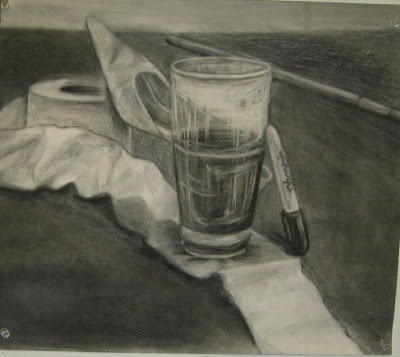


September 20th : Positive and Negative shapes in the Picture Plane
In today's class we will be building on our work in the last class (using major points on an x and y axis within the figure to help with proportion and placement) and start folding in the mapping of the whole picture plan. We will be paying close attention to the creation of negative space and how it balances the positive space. We will also be looking at the role that space and volume play in creating composition.
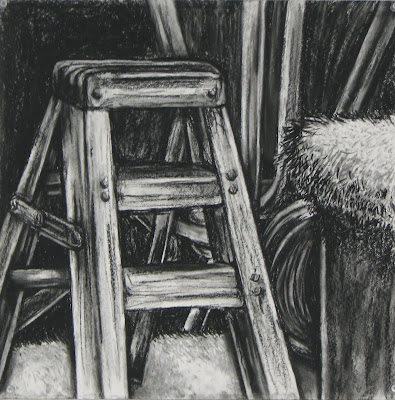
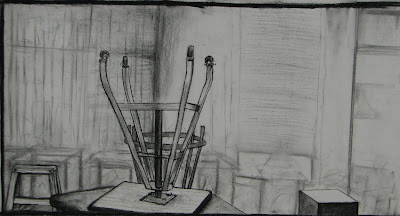
We will be starting by using stools and chairs (very geometric objects) to design a drawing that divides the page into positive and negative shapes. Below are a few examples from past years.
 In the drawing above you can still see some of the mapping lines this student was using to find the correct relationships between the main points of each object.


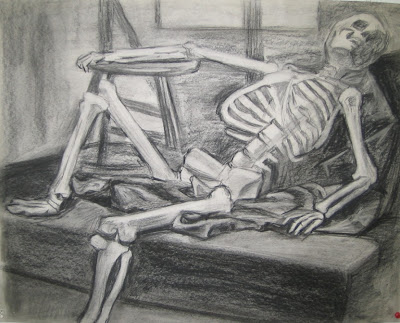
 For the second part of the day we will bring in more organic elements (the human skeleton and fabric) into a second drawing. Our concentration will still be on strong compositional layout through use of positive and negative space.
Below are some past drawings as examples.


We will be starting by using stools and chairs (very geometric objects) to design a drawing that divides the page into positive and negative shapes. Below are a few examples from past years.


Below are some past drawings as examples.


September 13th - Homework
Students are to complete the following assignment and bring it to class on September 20th.
Assignment: Degas Compositional Study
Find an image of an Edgar Degas painting. The image can be found online or from a book, but you must have (vie xerox, printer etc.) a physical copy of the painting. It should be no smaller than 8.5" x 11". The copy may be black and white as long as the image is clear. After you have the image, create a tracing paper overly by taping the two top corners of the tracing paper to the image. You are then to look for all the compositional elements that Degas has used in the painting and trace them out on the overlay.
Composition is the arrangement of various elements in the given picture plane. Composition is used to control the viewers eye as it moves through the image. Some elements of composition frequently used are vertical, horizontal and diagonal lines (often forming larger geometric shapes such as triangles and zigzags), repeating shapes and colors, scale of shapes, balancing of positive and negative space, placement of significant features (heads, torsos, arms and legs) and pointers (the directionality of people or objects gaze that have a specific "face"). Below are examples of some of these elements found in one Degas painting.
Here Degas uses the transition of the color in the ground plane to create a strong right and upward pointing triangle, with the standing figure creating the base. You can see how it is intensified by the direction of the gaze of the standing figure. The top horizontal line even seems to bee coming right out of her eyes.
 Here again Degas creates a strong right facing triangle, this time angling downward to balance the first one, through his placement of the tops and bottoms of the figures clothing.
 Here you can see him using the color of the the clothing, complimented by the reduction in scale to create movement.
 Again he is is using the repeating color and shape of the hair to push us across the image.
Assignment: Degas Compositional Study
Find an image of an Edgar Degas painting. The image can be found online or from a book, but you must have (vie xerox, printer etc.) a physical copy of the painting. It should be no smaller than 8.5" x 11". The copy may be black and white as long as the image is clear. After you have the image, create a tracing paper overly by taping the two top corners of the tracing paper to the image. You are then to look for all the compositional elements that Degas has used in the painting and trace them out on the overlay.
Composition is the arrangement of various elements in the given picture plane. Composition is used to control the viewers eye as it moves through the image. Some elements of composition frequently used are vertical, horizontal and diagonal lines (often forming larger geometric shapes such as triangles and zigzags), repeating shapes and colors, scale of shapes, balancing of positive and negative space, placement of significant features (heads, torsos, arms and legs) and pointers (the directionality of people or objects gaze that have a specific "face"). Below are examples of some of these elements found in one Degas painting.
 |


August 30th - The Gesture
A gesture drawing is a fast (typically 1-5 minutes) drawing that is used to capture the essential elements of the figures pose. The essence so to speak. A successful gesture is able to show where the stress, tension, implied movement, mass and weight of the figure are. There are an unlimited number of ways to show these qualities trough the application of line. Your line variety and relationships to each other are what will give these various qualities life. Below are several examples of gesture drawings done in class.


Subscribe to:
Posts (Atom)